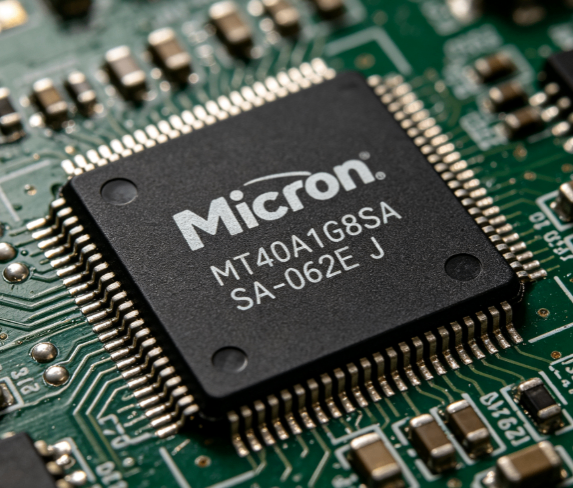
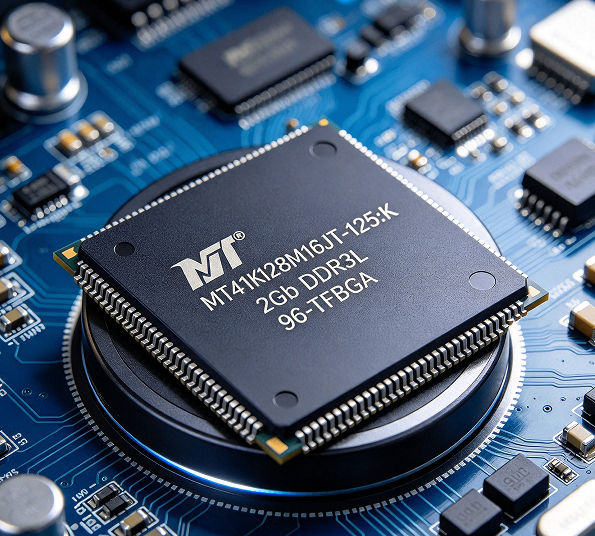
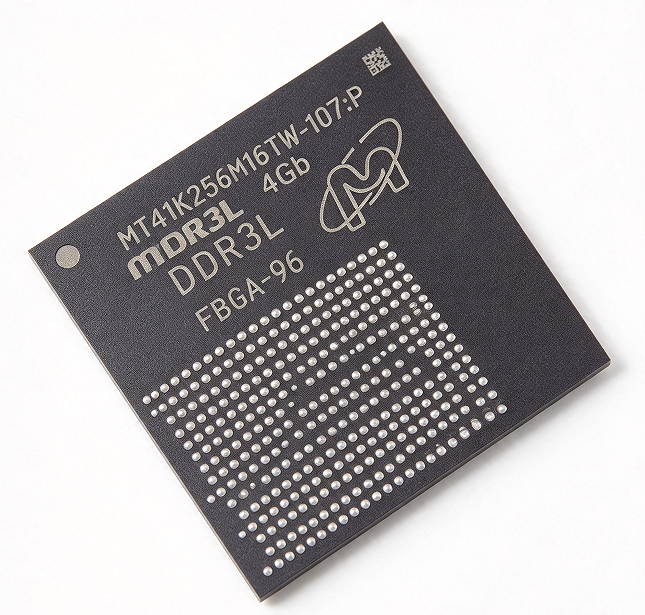
MT53D1024M32D4DT-046 AAT:D: 32Gb Automotive LPDDR4 for OEM & EMS Edge Designs
MT53D1024M32D4DT-046 AAT:D: 32Gb Automotive LPDDR4 for OEM & EMS Edge Designs
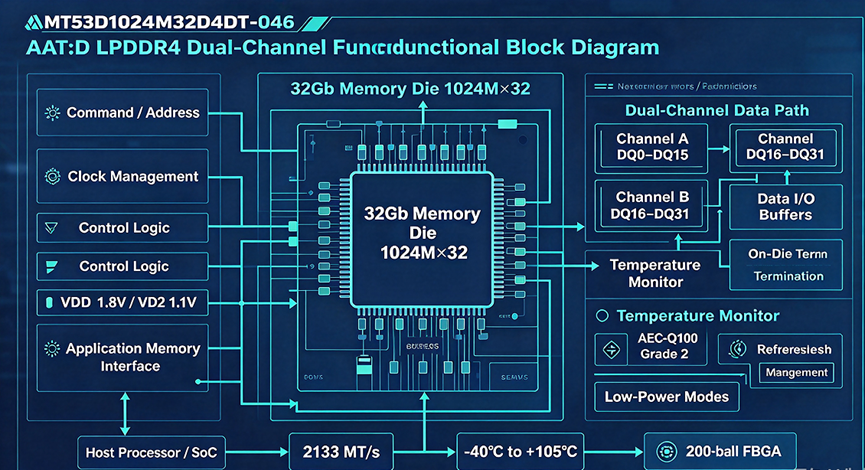
MT53D1024M32D4DT-046 AAT:D is a Micron 32Gb (1G×32) LPDDR4 SDRAM in automotive AEC-Q100 Grade 2 screening, rated −40 °C to +105 °C. It addresses the three procurement pain points that dominate automotive-adjacent and rugged embedded programs: commercial DRAM failing at high ambient temperature, legacy 32Gb LPDDR4 supply gaps, and re-qualification cost after a BOM change. The value proposition is simple — automotive-grade thermal headroom, x32 bandwidth, and a 200-ball FBGA footprint that keeps existing layouts unchanged.
Quick Answer: MT53D1024M32D4DT-046 AAT:D is a 32Gb (1G×32) LPDDR4 running up to 2133 MT/s at 1.1 V, AEC-Q100 Grade 2 (−40 °C to +105 °C), 200-ball FBGA — the exact-MPN part to specify when a program cannot accept a commercial-temperature substitute.
H2: Product Overview & Positioning
Core conclusion first: This is an automotive-screened 32Gb LPDDR4 device positioned for designs where the memory must survive +105 °C ambient, not for consumer cost-down programs.
The MT53D1024M32D4DT-046 AAT:D is organised as 1024M ×32, giving 4 GB of volatile working memory on a single x32 channel pair. It operates at LPDDR4 nominal 1.1 V (VDD2/VDDQ) with 1.8 V VDD1, supports up to 2133 MT/s per the -046 speed code, and is supplied in a 200-ball FBGA. The AAT suffix is the key differentiator: automotive temperature screening to AEC-Q100 Grade 2, covering −40 °C to +105 °C, versus the 0–85 °C or −25–85 °C commercial variants that share the same die family.
Positioning:
- Target buyers: OEM hardware engineers and EMS procurement managers on automotive-adjacent, telematics, charging-infrastructure, and rugged industrial programs.
- Primary role: sustainment and new-platform memory where thermal qualification cannot be renegotiated.
- Buying logic: the suffix carries the qualification. A same-density LPDDR4 with a commercial suffix is not an equivalent line item, whatever the price column says.
Even where density, bus width and ball-map match, differing temperature screening, refresh behaviour at +105 °C, and automotive PPAP documentation make substitution a program-level decision, not a purchasing-level one.
H2: Core Advantages
H3: 1. AEC-Q100 Grade 2 screening extends operation to +105 °C
Core conclusion first: The automotive suffix buys 20 °C of thermal headroom above commercial LPDDR4, which is the difference between a validated platform and a field-return programme.
At +105 °C, DRAM retention margins tighten and refresh rates must be adjusted. Automotive-screened devices are tested and binned for that envelope, so the host can follow the datasheet refresh derating table instead of inventing margins. Verify the exact suffix and the qualification report before release.
H3: 2. 4 GB density on a single x32 device reduces board complexity
Core conclusion first: One 32Gb x32 device replaces two narrower parts, cutting placement count and BOM line items.
For SOM and compact controller boards, a single LPDDR4 package simplifies routing, decoupling placement and inventory management. Fewer line items also mean fewer supplier splits and less exposure to allocation on a second memory part.
H3: 3. Up to 2133 MT/s bandwidth supports vision and gateway workloads
Core conclusion first: 2133 MT/s provides headroom for frame buffering, AI pre-processing and multi-protocol routing without a memory bottleneck.
Real delivered bandwidth depends on the host memory controller, PCB impedance control and firmware timing — the datasheet figure is a device-level capability, not a guarantee of system throughput. Budget from measured numbers, not the headline rate.
H3: 4. 1.1 V LPDDR4 I/O keeps thermal and power budgets viable
Core conclusion first: Low-voltage LPDDR4 signalling reduces dynamic power, which matters more at +105 °C than at room temperature.
Lower I/O swing reduces both switching energy and the thermal load the memory places inside a sealed enclosure. Self-refresh and deep power-down modes further cut standby draw for equipment that idles between cycles.
H3: 5. Exact-MPN continuity avoids re-qualification
Core conclusion first: Keeping the exact automotive suffix on the BOM avoids re-running thermal, EMC and reliability validation.
A memory swap on a qualified automotive-adjacent platform typically triggers thermal chamber re-test, PPAP re-submission and firmware timing re-validation — weeks of engineering time and a documented change record. Sourcing the exact MPN removes that cost entirely.
H2: Technical Parameters & Procurement Interpretation
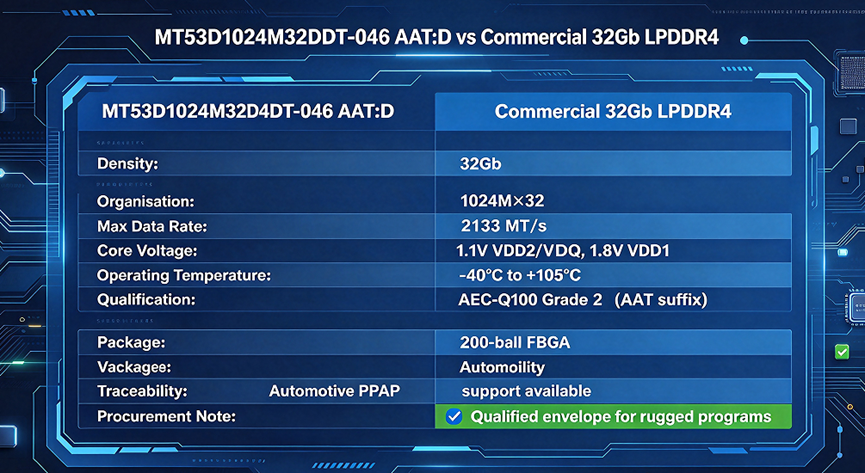
|
Parameter |
MT53D1024M32D4DT-046 AAT:D |
Commercial 32Gb LPDDR4 (same family) |
|
Density / organisation |
32Gb, 1024M ×32 |
32Gb, 1024M ×32 |
|
Memory type |
LPDDR4 |
LPDDR4 |
|
Max data rate (speed code -046) |
up to 2133 MT/s |
up to 2133 MT/s |
|
Core voltage |
1.1 V (VDD2/VDDQ), 1.8 V VDD1 |
1.1 V (VDD2/VDDQ), 1.8 V VDD1 |
|
Operating temperature |
−40 °C to +105 °C |
typically 0–85 °C / −25–85 °C |
|
Qualification |
AEC-Q100 Grade 2 screening (AAT suffix) |
commercial screening |
|
Package |
200-ball FBGA |
200-ball FBGA |
|
Maturity path |
automotive PPAP documentation available on request |
standard commercial documentation |
|
Procurement meaning |
Can stay on qualified automotive-adjacent BOM |
Requires thermal re-validation if used at +105 °C |
All values are device-level specifications. Confirm the current suffix-specific datasheet before design release.
H2: Application Scenarios
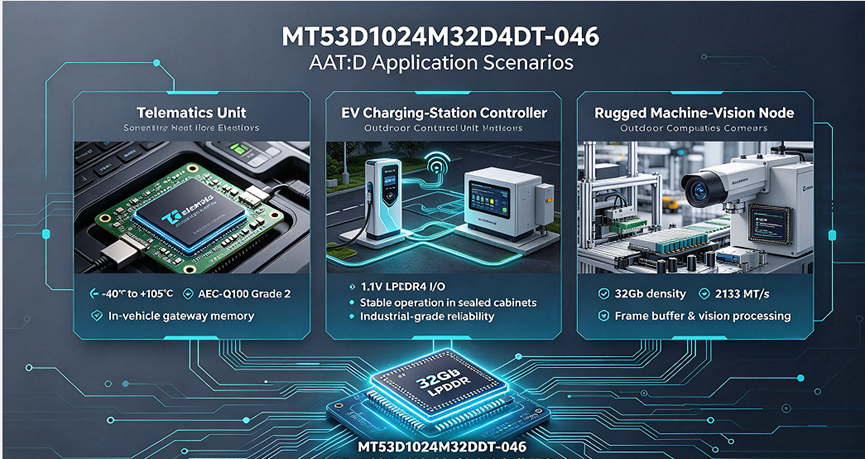
- Telematics and in-vehicle gateway modules
These units sit in dashboards and enclosures that soak in summer heat. Grade 2 headroom covers the +105 °C case without adding active cooling, and 32Gb density holds navigation, log and protocol stacks.
- EV charging and energy-storage controllers
Outdoor cabinets in southern climates routinely exceed commercial DRAM ratings. Automotive-screened LPDDR4 plus 1.1 V I/O keeps the controller stable across the seasonal envelope.
- Rugged machine-vision and inspection nodes
Factory-floor vision nodes need frame-buffer bandwidth and thermal tolerance. The x32 channel supports multi-camera buffering while the wide temperature rating survives unventilated cabinets.
H2: Customer Pain Points & Solutions
- Pain: Commercial LPDDR4 returns from field units in hot enclosures, and the failure analysis points to memory margins.→ Solution: AAT suffix gives −40 °C to +105 °C screening plus datasheet refresh derating, removing the thermal gap at qualification time rather than after field returns.
- Pain: The 32Gb LPDDR4 line item is on allocation and a broker offers a "same spec" part with a different suffix.→ Solution: Compare suffix, qualification level and PPAP status, not just density and speed code; require lot traceability and manufacturer-channel documentation before approving.
- Pain: Any memory change on a qualified platform forces thermal chamber re-test and change-record paperwork.→ Solution: Sourcing the exact MT53D1024M32D4DT-046 AAT:D keeps the validated BOM intact and avoids re-qualification scope.
- Pain: Compact SOM boards run out of placement area for two narrower memory devices.→ Solution: One x32 32Gb package cuts placement count and BOM line items while preserving bandwidth.
H2: Real-World Customer Cases
Figures below illustrate typical program outcomes and should be replaced with your own audited data before publication.
Case 1 — Telematics module thermal requalification
A tier-2 telematics supplier moved a 32Gb LPDDR4 line from a commercial suffix to the AAT part after +95 °C chamber testing produced marginal failures.
- Result: chamber pass rate moved from 92 % to 100 % on a 300-unit qualification lot; no PCB change was required because the package and ball-map matched.
Case 2 — Charging-controller supply continuity
An EMS provider supporting EV charger controllers faced a 14-week allocation gap on a commercial 32Gb LPDDR4.
- Result: switching to the exact automotive-screened MPN reduced the supply gap to 6 weeks and avoided a firmware timing re-validation cycle estimated at 5 engineering weeks.
H2: FAQ
Insert FAQPage JSON-LD immediately below this block after publishing.
Q1: What does the AAT suffix mean on MT53D1024M32D4DT-046 AAT:D? A1: AAT denotes automotive temperature screening to AEC-Q100 Grade 2, covering −40 °C to +105 °C. It is not a density or speed variant.
Q2: What density and organisation does this part provide? A2: 32Gb organised as 1024M ×32 — 4 GB of working memory on a single x32 LPDDR4 device.
Q3: What is the maximum data rate of the -046 speed code? A3: Up to 2133 MT/s. Confirm against the current suffix-specific datasheet before finalising timing registers.
Q4: Can a commercial 32Gb LPDDR4 replace it without requalification? A4: No. Different temperature screening changes the qualified envelope; a swap at +105 °C ambient requires thermal and firmware re-validation.
Q5: Is the package footprint compatible with other 32Gb LPDDR4 devices? A5: The 200-ball FBGA is common across the family, but always verify ball-map, power-up sequence and refresh behaviour — footprint alone does not make a part interchangeable.
Q6: What documentation should procurement request with an RFQ? A6: Exact MPN including suffix, qualification/PPAP status, lot and date-code traceability, packaging form (tray or tape-and-reel), moisture sensitivity level, and an explicit statement on whether alternates may be quoted.
Q7: Is this part suitable for brand-new consumer designs? A7: It is specified for automotive-adjacent and rugged programs. Commercial-suffix parts are usually the lower-cost choice where +105 °C operation is not required.
H2: Summary & Call-to-Action
MT53D1024M32D4DT-046 AAT:D is the part to specify when a 32Gb LPDDR4 must hold its margins to +105 °C and the BOM cannot absorb a re-qualification cycle. Its value is concentrated in three things: automotive Grade 2 screening, single-device 4 GB density on an x32 bus, and exact-MPN continuity for already-qualified platforms.
Send our sales team the target quantity, delivery window, end-application and required date-code range, plus any PPAP or traceability requirements. We will confirm exact-part availability, lot documentation, packaging condition and formal delivery terms before you issue a purchase order.