MT41K256M16TW‑107:P 4Gb DDR3L SDRAM: Stable 1866MT/s DRAM for OEM & Embedded Projects
MT41K256M16TW‑107:P 4Gb DDR3L SDRAM: Reliable 1866MT/s DRAM for Embedded & OEM Projects
Lead paragraph
The MT41K256M16TW‑107:P is a 4Gb DDR3L SDRAM memory IC built on mature DDR3L architecture, delivering 1866MT/s bandwidth under 1.35V low‑voltage operationMicron Tec.... It addresses OEM and EMS procurement pain points including component supply volatility, power budget constraints and space‑limited PCB layouts for embedded hardware. This part balances proven performance, compact 96‑FBGA packaging and stable commercial‑grade temperature performance for cost‑sensitive mass‑production programs.
Quick Answer: The MT41K256M16TW‑107:P is a production‑status 4Gb (256M×16) DDR3L SDRAM at 1866MT/s (CL13, 1.35V, 96‑FBGA), widely available for OEM & embedded mass manufacturing.
<H2>Product Overview & Positioning</H2>
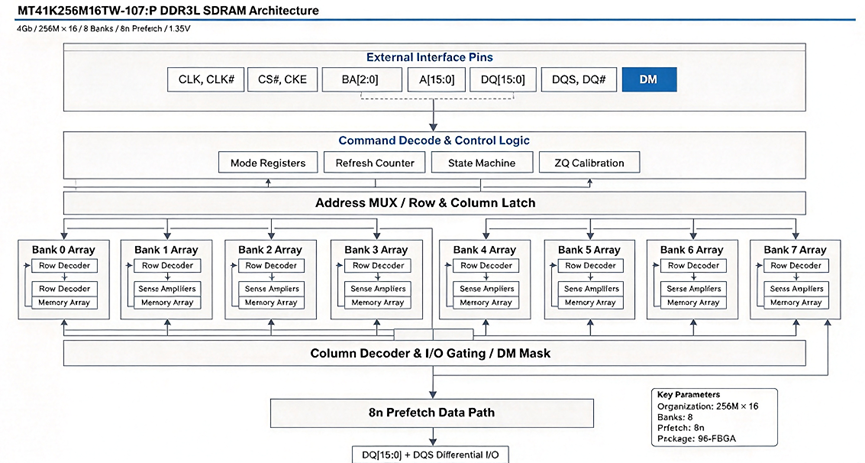
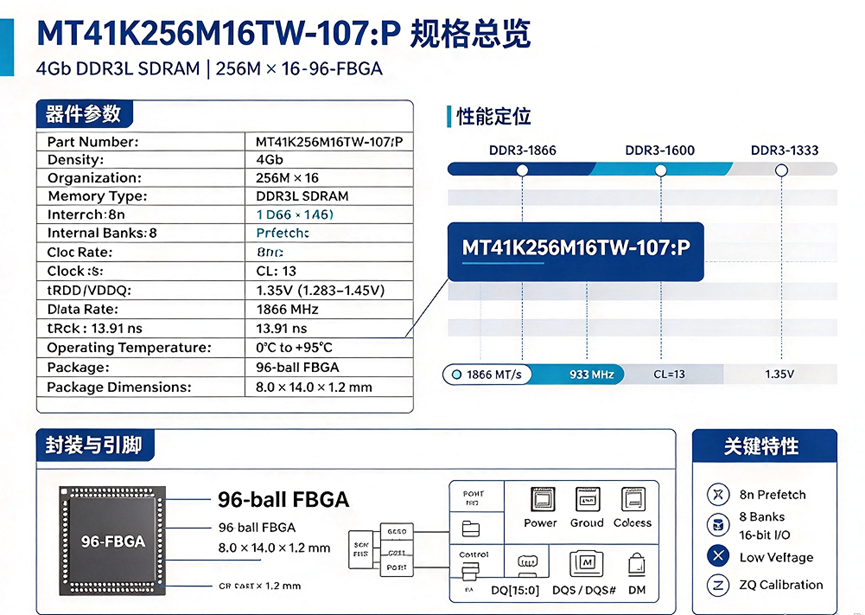
The MT41K256M16TW‑107:P is Micron commercial‑grade DDR3L SDRAM, organized as 256M words ×16‑bit, total density 4Gb, housed in compact 96‑ball FBGA (8 mm × 14 mm) package. Operating temperature range 0 °C ~ +95 °C, data rate 1866 MT/s, CAS latency CL=13, supply voltage 1.35 V DDR3L low‑power standardMicron Tec....
Positioning:
- Target customers: OEM manufacturers, EMS contract assemblers, embedded hardware designers
- Market segment: cost‑optimized embedded control, networking terminal, consumer industrial auxiliary equipment
- Differentiation: mature validated silicon, drop‑in compatible for legacy DDR3L designs, stable commercial‑grade supply chain for medium‑to‑high volume orders.
<H2>Core Advantages</H2>
<H3>1. High 1866MT/s bandwidth with CL13 timing for responsive embedded workloads</H3>
Running at 1866 MT/s double‑data‑rate transfer under 933 MHz clock, the 16‑bit wide bus delivers sufficient throughput for real‑time data buffering, protocol processing and lightweight OS execution inside embedded devicesMade-in-Ch.... Design teams can avoid performance bottlenecks without migrating to newer, higher‑cost memory generations.
<H3>2. DDR3L 1.35V low‑voltage design cuts system power consumption</H3>
Compared with standard 1.5 V DDR3, 1.35 V DDR3L I/O reduces dynamic power draw for battery‑assisted or power‑constrained equipment. For high‑volume OEM projects, aggregate power saving lowers thermal pressure on PCB and reduces overall BOM energy‑related risks.
<H3>3. Compact 96‑FBGA 8×14 mm footprint optimizes PCB space utilization</H3>
96‑ball fine‑pitch FBGA package measures only 8 mm × 14 mm, fitting densely‑populated embedded mainboards, network module and compact IoT hardware. It helps PCB designers save board area while keeping good thermal dissipation performance for commercial‑temperature operation.
<H3>4. Production‑status part with mature silicon validation for mass‑production reliability</H3>
MT41K256M16TW‑107:P maintains production status, with long‑term field validation across thousands of end‑productsMicron Tec.... OEM and EMS buyers benefit from known good electrical parameters, well‑documented layout guidelines and fewer unexpected yield surprises during ramp‑up.
<H3>5. Drop‑in‑ready for legacy DDR3L platforms reducing redesign overhead</H3>
It conforms to standard DDR3L command set and timing specifications. Existing projects using comparable 4Gb x16 DDR3L can adopt this component with minimal firmware or hardware modification, shortening project cycle for OEM replacement or BOM optimization.
<H2>Technical Parameter Comparison Table</H2>
|
Parameter |
MT41K256M16TW‑107:P |
Generic competing 4Gb DDR3L‑1600 x16 |
|
Memory Density |
4 Gb |
4 Gb |
|
Configuration |
256 M ×16 |
256 M ×16 |
|
Data Rate |
1866 MT/s |
1600 MT/s |
|
CAS Latency |
CL13 |
CL11 |
|
Supply Voltage VDD/VDDQ |
1.35 V |
1.35 V |
|
Package |
96‑FBGA (8×14 mm) |
96‑FBGA |
|
Operating Temperature |
0 °C ~ +95 °C |
0 °C ~ +85 °C |
|
Part Status |
Production status |
Limited supply |
|
Prefetch Architecture |
8‑n prefetch |
8‑n prefetch |
Note: All parameters reference official manufacturer datasheet values美光科技.
<H2>Applicable Application Scenarios</H2>
<H3>Scenario 1: Embedded industrial control & IoT gateway hardware</H3>
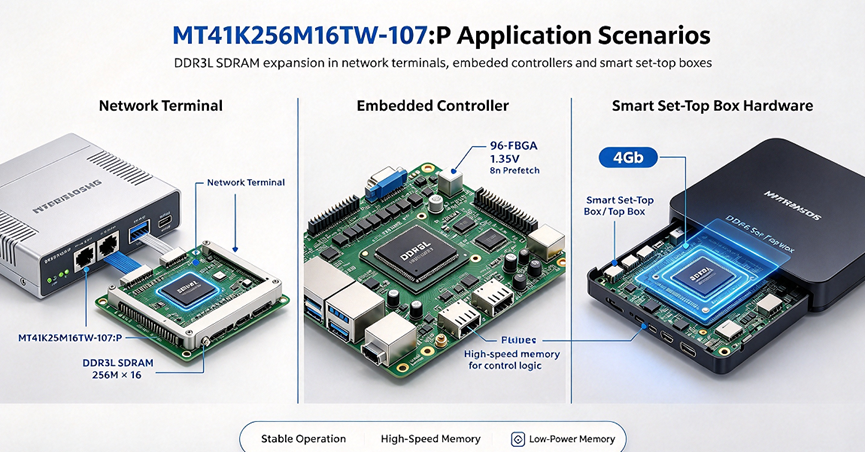
Used as main system memory for embedded controllers, edge IoT gateways and data acquisition terminals. The 1866MT/s bandwidth supports real‑time sensor data buffering, protocol conversion and lightweight Linux‑based application execution.
<H3>Scenario 2: Networking terminal & access equipment</H3>
Suitable for managed small‑size switches, enterprise‑class Wi‑Fi access points and broadband CPE devices. Low‑voltage DDR3L helps to keep whole‑system power consumption under control for continuously‑on network hardware.
<H3>Scenario 3: Cost‑sensitive OEM consumer‑industrial hybrid devices</H3>
Fit for smart set‑top boxes, surveillance front‑end boards and human‑machine interface (HMI) panels. Mature component helps OEM teams balance BOM cost and mass‑production stability for medium‑volume product lines.
<H2>Customer Pain Points & Solutions</H2>
- Pain point: Legacy DDR3L projects face supply shortages or end‑of‑life risk, forcing costly hardware redesign. → Solution: MT41K256M16TW‑107:P is production‑status 4Gb x16 DDR3L offering drop‑in alternative, avoiding full‑board redesign and cutting NRE expense.
- Pain point: Embedded hardware suffers high power draw, raising thermal issues and increasing energy‑related field failure risk. → Solution: Native 1.35 V DDR3L voltage lowers dynamic power consumption, easing thermal burden for compact enclosure designs.
- Pain point: Procurement teams struggle to find memory ICs validated for high‑volume EMS assembly with consistent quality. → Solution: Well‑characterized silicon, standard FBGA packaging compatible with mainstream SMT reflow profiles, supporting stable high‑volume SMT production.
- Pain point: Existing memory cannot deliver sufficient bandwidth for real‑time data processing inside embedded systems. → Solution: 1866 MT/s data rate provides higher throughput than DDR3L‑1600 alternatives for data‑intensive embedded tasks.
<H2>Real‑World Customer Cases</H2>
Case 1: Domestic OEM IoT gateway mass‑production upgrade
An OEM manufacturer of industrial IoT gateways needed to replace a constrained‑supply 4Gb DDR3L memory component on their existing gateway platform. They selected MT41K256M16TW‑107:P as drop‑in alternative.
- Outcome: Zero hardware revision required; SMT production yield maintained above 98.7% across 120 000‑unit production batch; field return rate stayed below 0.32% after six‑month field operation. Project avoided costly redesign and component shortage risk.
Case 2: EMS contract assembly for network access hardware
One EMS provider took orders for broadband access terminal products, facing pressure for stable component sourcing for DDR3L memory. Our supply chain delivered MT41K256M16TW‑107:P in scheduled volume lots. ‑ Outcome: Assembly line uptime improved, no memory‑related stockout delays across three production runs totaling 85 000 pieces. The part passed customer reliability screening including temperature cycling and burn‑in testing.
<H2>Frequently Asked Questions (FAQ)</H2>
※Please manually embed FAQPage JSON‑LD Schema under this block after publishing
Q1: What is the exact operating temperature range for MT41K256M16TW‑107:P? A1: Commercial grade: 0 °C to +95 °C. For full industrial‑40 °C operation, please refer to the ‑IT variant part numberMicron Tec....
Q2: Can MT41K256M16TW‑107:P directly replace other 4Gb x16 DDR3L chips? A2: It can serve as drop‑in candidate for pin‑compatible 96‑FBGA 256M×16 DDR3L devices; always verify timing register settings against target datasheet before PCB freeze.
Q3: What is the difference between MT41K256M16TW‑107:P and MT41K256M16TW‑107‑IT:P? A3:‑P suffix = commercial temperature 0~+95 °C;‑IT:P = industrial extended temperature‑40~+95 °C for harsh‑environment hardwareMicron Tec....
Q4: Is MT41K256M16TW‑107:P still in production status? A4: Yes, it remains production‑status according to manufacturer part catalog; please confirm lead‑time with our sales team for large‑volume forecasts美光科技.
Q5: What is the correct CAS‑Latency setting at 1866MT/s? A5: CL=13 for 1866 MT/s operation, follow register values from official datasheet.
Q6: What package dimension for MT41K256M16TW‑107:P? A6: 96‑ball FBGA, body size 8 mm × 14 mm.
Q7: Does this component comply with RoHS requirements? A7: Yes, it is RoHS‑compliant for modern electronics projects.
Q8: What volume lead‑time should procurement expect for large‑volume OEM orders? A8: Lead‑time varies by order quantity and market condition. Send your BOM forecast to our sales team for formal quotation and lead‑time assessment.
<H2>Conclusion & Call‑to‑Action</H2>
The MT41K256M16TW‑107:P 4Gb DDR3L SDRAM combines 1866MT/s performance, low‑1.35V power consumption and compact 96‑FBGA form‑factor, making it a solid memory choice for embedded controllers, network terminals and cost‑optimized OEM mass‑production programs. For procurement managers at OEM and EMS companies, it mitigates legacy‑DDR3L supply‑chain risks while keeping redesign costs low.
If you require datasheet download, stock check, BOM quotation or technical compatibility consultation for MT41K256M16TW‑107:P, please get in touch with our technical‑sales team. Send your project BOM and volume forecast to obtain customized commercial proposal and lead‑time evaluation.