MT53E768M32D4DT-053 WT:E: 24Gb Commercial Grade LPDDR4 SDRAM for Embedded OEM and EMS Procurement
MT53E768M32D4DT‑053 WT:E: 24Gb Commercial‑Grade LPDDR4 SDRAM for Embedded OEM and EMS Procurement
Quick Answer
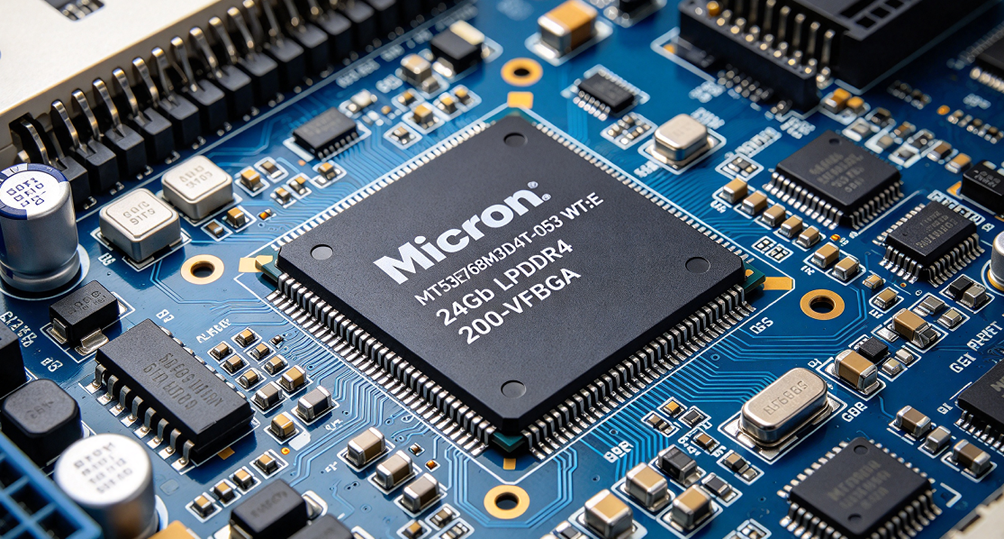
ApplicationsMT53E768M32D4DT‑053 WT:EWhen your frozen bill of materials requires a 24Gb (768M×32) LPDDR4 SDRAM, with a compact 200‑VFBGA package (10.0 × 14.5 × 0.95 mm), rated operating temperature of−25 °C ~ +85 °C, with a peak data rate of 3733 MT/s. Before bulk purchasing, be sure to verify the batch status, date code, and lifecycle condition.
Introduction
MT53E768M32D4DT‑053 WT:E is a 24Gb LPDDR4 low-power SDRAM memory chip from Micron, featuring a 768M ×32 organization. It is specifically designed for embedded motherboards, human-machine interfaces, and edge computing hardware. Micron's technology ensures high bandwidth while maintaining low active power consumption and self-refresh power consumption, helping to alleviate thermal and power constraints in space-constrained embedded designs. For electronic component procurement managers and OEM/EMS suppliers, its core value lies in verifying the electrical performance of existing certified platforms; it is primarily used to sustain production needs for systems with locked BOMs, rather than being the preferred choice for new products or entirely new design solutions. This product is a volatile, surface-mount DRAM component and does not provide non-volatile data storage functionality.
Product Overview and Positioning
First, let's present the key conclusions.: MT53E768M32D4DT‑053 WT:E is a commercial‑grade LPDDR4 SDRAM designed for validated embedded products, suitable for scenarios where pin‑compatible memory replacements may introduce board‑level signal integrity, firmware, and timing verification risks. Micron Technology…
This device complies with the JEDEC LPDDR4 standard, comes in a 200‑VFBGA package, features a 16n prefetch architecture and eight internal banks per channel, and supports Partial Array Self‑Refresh (PASR), an on‑die temperature sensor, as well as programmable read/write latency; static 6.ar… The nominal supply voltage is VDD1 1.8 V, VDD2/VDDQ 1.1 V. The operating temperature range is−25 °C ~ +85 °C commercial grade; itHas not passed AEC‑Q100 automotive-grade certificationAnd there is no official documentation from Micron Technology...
Although other 24Gb LPDDR4 devices are already available on the market, simply matching density, bus width, or interface version does not guarantee that their ball grid array (BGA) footprint, timing parameters, power-up initialization sequence, or self-refresh characteristics will be exactly the same. Engineering teams must conduct comprehensive signal integrity, firmware, and thermal validations for any proposed direct replacement solution.
Four Core Advantages of OEM/EMS Embedded Assurance Projects
- High-bandwidth LPDDR4 interface and low-power modes
First, let's present the key conclusion: Peak data rates up to 3733 MT/s, combined with multiple low-power self-refresh modes, can balance power efficiency between high-performance operation and idle states.
This device supports a 1866 MHz clock, delivering 3733 Each pin has a data rate of MT/s, suitable for GUI rendering, multithreaded application workloads, and moderately complex embedded computing. The PASR partial array self-refresh feature allows the host to shut down unused memory segments, thereby reducing idle power consumption. Note: The actual achievable bandwidth depends on the host memory controller, PCB signal integrity, impedance control, and firmware timing configurations; the published maximum values are benchmark figures under laboratory conditions and do not guarantee system throughputstatic6.ar....
- Compact 200‑VFBGA package, ideal for space-constrained PCB layouts
First, let's present the core conclusion: 10.0 × 14.5 × 0.95 With a thickness of only 0.95 mm, the 200‑VFBGA package is perfectly suited for high-density embedded motherboard designs with strict height constraints.
The fixed 200-ball VFBGA package form factor is critical for hardware with existing BOM lock-in. When evaluating alternative storage devices, it is essential to verify the package's ball grid array distribution, mechanical thickness, and reflow soldering process profile. Additionally, when selecting or replacing components, the package height requirements should be re-evaluated based on the enclosure's mechanical constraints.
- On-Chip Monitoring and Flexible Timing Configuration
First, let's state the core conclusion: An integrated temperature sensor combined with programmable RL/WL delays helps the system achieve dynamic thermal-aware refresh and adapt to the host controller's timing margins.
The built-in temperature sensor enables host firmware to adjust the self-refresh rate according to the junction temperature, ensuring data retention while optimizing power consumption. Read/write delays can be dynamically programmed at runtime, enhancing interoperability across different host SoC implementations. However, after any hardware or storage component replacement, comprehensive system validation remains necessary.
- LPDDR4 compliant with JEDEC standards ensures continuity for qualified legacy platforms
First, let's state the core conclusion: A standards-compliant LPDDR4 implementation can provide verified boot and runtime memory behavior, ensuring production continuity for OEM/EMS customers with a frozen BOM.
For platforms that have been fully validated around the MT53E768M32D4DT‑053 WT:E, using the exact MPN avoids costly re-certification of memory controller tuning, power-up sequences, thermal profiles, and stress test cycles. This component is primarily recommended for production continuity rather than new designs, where newer LPDDR4/LPDDR4X solutions are preferred.
Technical Parameters and Procurement Interpretation Table
|
Parameter |
Published Value |
Procurement Implications |
|
Manufacturer |
Micron Technology |
Please verify the complete part suffix, markings, and traceability documents; do not rely solely on market listing titles. |
|
Memory Density |
24Gb, organization structure 768M × 32 |
The host memory controller must support the LPDDR4 32-bit bus configuration |
|
Interface |
JEDEC LPDDR4 |
The host SoC memory controller must support LPDDR4; please confirm the firmware initialization sequence. |
|
Peak data rate |
3733 MT/s (at 1866 MHz clock) Laboratory test maximum value; actual bandwidth depends on PCB signal integrity and controller settings. |
Package |
|
200‑VFBGA (D9WRQ) |
Before evaluating alternative solutions, please verify the ball grid array diagram, package dimensions, and reflow soldering process curve. |
Dimensions |
|
10.0 |
10.0 × 14.5 × 0.95 mm maximum |
Please check the clearance requirements for the mechanical enclosure height. |
|
Operating temperature |
−25 °C ~ +85 °C |
Commercial grade; not certified to automotive AEC‑Q100, no formal qualification report. |
|
Supply voltage |
VDD1 1.8 V; VDD2/VDDQ 1.1 V |
Must match the circuit board power rail design and power-up sequence requirements. |
|
Key Features |
PASR, on-chip temperature sensor, programmable RL/WL |
System firmware requires corresponding driver support to utilize low-power features. |
Note: Please use this form for bill-of-materials screening and quotation preparation. The final engineering release must refer to Micron's official MT53E768M32D4DT‑053 WT:EMicron Tec datasheet…
Applicable Application Scenarios
Traditional industrial human-machine interfaces and embedded operation terminals
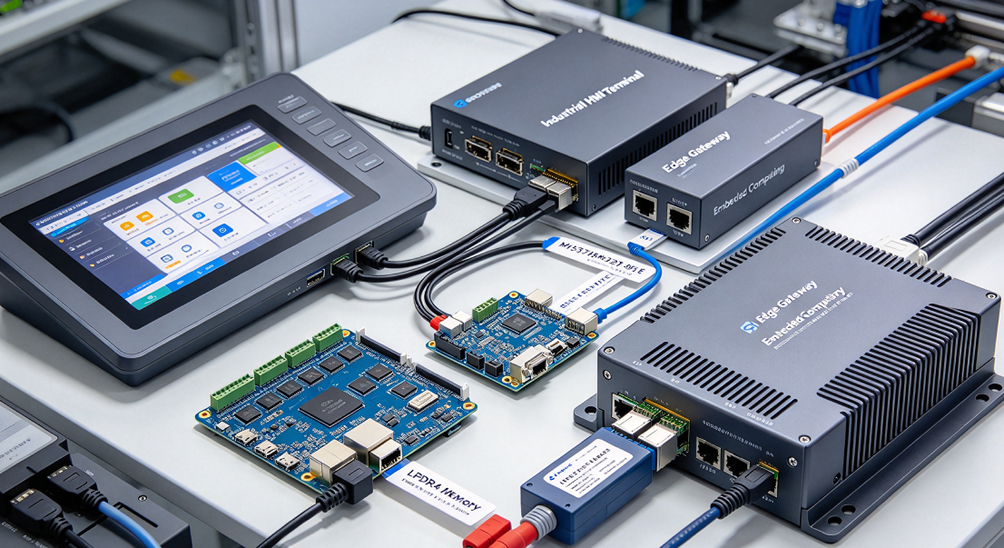
Mature human-machine interface terminals employ this LPDDR4 in memory, GUI frame buffers, and multitasking operating system spaces during runtime. When conducting batch production qualification for incoming material batches, it is necessary to verify power sequencing, thermal design margins, memory controller tuning, and signal integrity.
Edge gateways and mid-performance embedded control units
Network edge gateways and embedded control units running Linux workloads rely on the trade-off between bandwidth and power consumption to achieve packet processing and local application execution. Since this product is intended for continuous supply, priority should be given to batch traceability and incoming material sampling inspections to ensure long-term hardware reliability in field deployments.
Mature smart instruments and commercial embedded devices
Published test and measurement instruments and commercial embedded devices still use the existing bill of materials, adopting MT53E768M32D4DT‑053 WT:E to avoid comprehensive hardware and firmware re-certification. New instrument designs should evaluate current-generation LPDDR4X replacement options.
Buyer pain points and practical countermeasures
|
Pain points |
Practical solutions adopted by OEM/EMS procurement |
|
Suppliers provide "functionally equivalent" 24Gb LPDDR4 as a direct replacement product |
Compare ball grid array layout, package dimensions, power-up sequencing, timing parameters, and self-refresh characteristics; before modifying the bill of materials, complete signal integrity and firmware verification must be performed. |
|
The lifecycle and obsolescence risk of MT53E768M32D4DT‑053 WT:E remain unclear. |
Manufacturers are requested to provide channel-level lifecycle declarations and dated quotations; third-party component databases are not authoritative sources for obsolescence notifications. |
|
Existing inventory includes components with early production dates and unclear storage histories. |
Review lot codes, MSL status of dry-packaged components, baking history, and solderability risks; implement risk-based sampling rules for incoming material inspection. |
|
The maximum value cited in marketing materials is 3733. Guaranteed actual system bandwidth measured in MT/s. |
Processing 3733. Lab‑tested maximum specification in MT/s; communicate realistic performance expectations to hardware and firmware engineering teams. |
|
Broker‑channel inventory lacks complete component traceability. |
Implement supplier qualification audits, photo labeling, batch traceability document management, and risk-adjusted incoming material inspection processes for memory orders. |
Lifecycle and Incoming Material Quality Control Guide
Key Conclusions First: Before placing MT53E768M32D4DT‑053 WT:E into large-scale continuous production orders, please confirm its official lifecycle status.
Public third-party component databases may display conflicting supply statuses. The procurement team must obtain relevant supporting documentation from authorized supplier channels, rather than relying solely on aggregated web-scraped data as the official basis for Micron notifications.
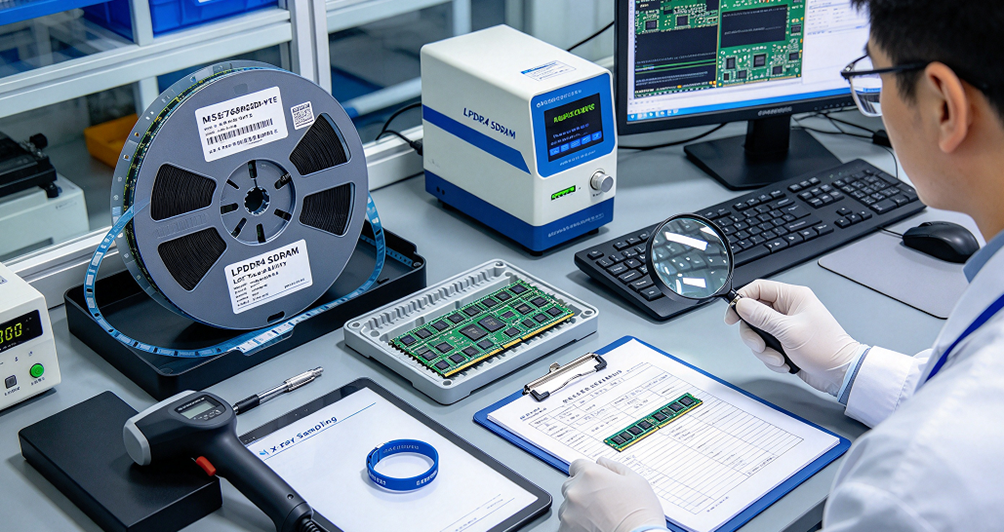
The practical incoming material control workflow for MT53E768M32D4DT‑053 WT:E includes the following steps:
- Conduct a comprehensive review of labels and documents for MPN, suffixes, lot numbers, and date codes.
- Visually inspect packaging and markings.
- For older batches, use risk-weighted X-ray sampling to verify the condition of spherical solder joints.
- Inspect moisture-sensitive devices using desiccant bags and humidity indicator cards.
- Develop reflow/baking process plans for inventory with earlier date codes.
- Conduct application-specific sampling verification: power-on startup tests, basic memory read/write functionality.
The level of inspection is adjusted based on supplier risk level, batch age, total order quantity, and the criticality of the end device.
Frequently Asked Questions (FAQ)
Q1: What are the density and bus width provided by MT53E768M32D4DT‑053 WT:E?A1: This is a 24Gb LPDDR4 SDRAM with an organization of 768M × 32. The host memory controller must be configured to a 32-bit LPDDR4 bus width to fully utilize the device's entire capacity.
Q2: What are the peak data rate and temperature grade supported by this device?A2: Up to 3733 MT/s (clock frequency 1866 MHz); Commercial operating temperature−25 °C ~ +85 °C, not officially certified by documentation, and does not meet automotive-grade standards.
Q3: 3733 Can MT/s guarantee memory bandwidth in actual systems?A3: 3733 MT/s represents the maximum speed under manufacturer laboratory conditions. Actual system bandwidth depends on the host controller, PCB signal integrity, impedance control, and firmware timing settings; system-level validation is required.
Q4: Can any other 24Gb LPDDR4 device be directly substituted?A4: No. Differences in ball grid array layout, power-up initialization, timing, and self-refresh characteristics may cause validated embedded platforms to fail to operate properly. Before approving the use of alternative storage devices, complete hardware, firmware, and signal integrity certifications must be completed.
Q5: Whether−25 °C ~ +85 Does the °C grade mean that MT53E768M32D4DT‑053 WT:E has passed the automotive-grade AEC‑Q100 certification?A5: Having only a commercial temperature grade does not equate to passing automotive-grade certification. If you intend to use this device in automotive systems, please request the official certification documents.
Q6: What information should be included in an RFQ for MT53E768M32D4DT‑053 WT:E?A6: Please submit a complete and accurate MPN number (including the suffix), the target quantity, the requested delivery date, the shipping destination, the acceptable date code range, packaging requirements (tray/reel), expectations regarding traceability documentation, inspection standards, and clearly indicate whether alternative component proposals are permitted.
Q7: What are the primary intended applications of MT53E768M32D4DT‑053 WT:E?A7: Used for the continued production of traditional industrial human-machine interfaces, edge gateways, and mature commercial embedded instruments; this product is optimized for existing frozen BOM platforms rather than being a completely new development project.
Request a project-specific quotation
MT53E768M32D4DT‑053 WT:E is ideally suited for ongoing projects that require 24Gb of commercial-grade LPDDR4 SDRAM in a compact 200‑VFBGA package, intended for embedded runtime memory as well as OEM and EMS platforms with existing frozen bill-of-materials. Please send your target purchase quantity, desired lead time, end-application details, acceptable date-code restrictions, and incoming-inspection requirements to our sales team. Before placing a purchase order, please confirm the availability of the specific part number, batch traceability, packaging condition, and formal delivery terms.